

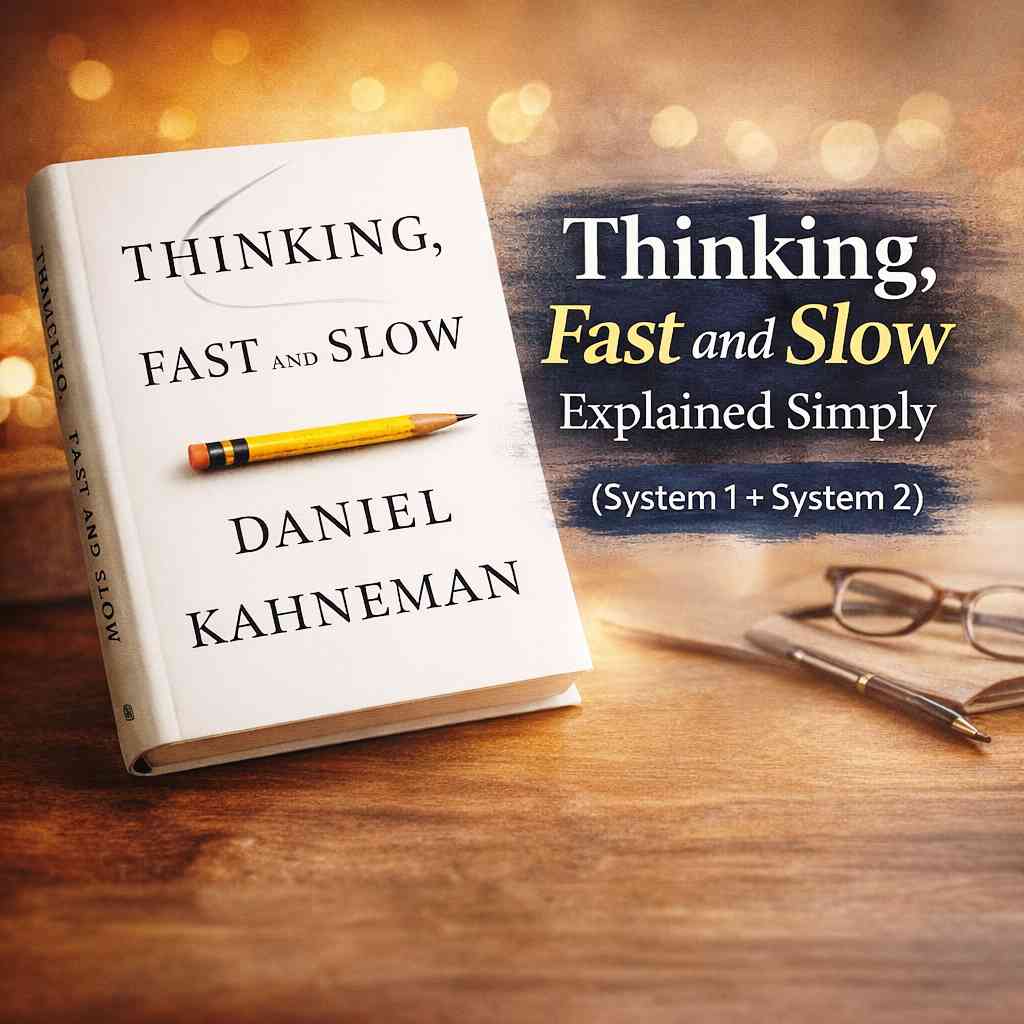
Thinking, Fast and Slow Made Simple: How System 1 and System 2 Work
Understanding how people think and make decisions is one of the most fascinating questions in psychology. In his bestselling book Thinking, Fast and Slow, psychologist Daniel Kahneman explores how our minds process information and why we often make mistakes in judgment.
Kahneman’s central idea is surprisingly simple:
Human thinking operates through two different mental systems.
These systems work together constantly, shaping how we interpret situations, form opinions, and make choices. Kahneman calls them System 1 and System 2.
Understanding these systems can help explain:
- why people jump to conclusions
- why first impressions feel powerful
- why careful reasoning sometimes fails
- why decision fatigue is real
By learning how these mental systems work, readers can better understand their own thinking patterns and make more thoughtful decisions.
The Two Systems of Thinking
Kahneman argues that the brain uses two distinct approaches to thinking.
These systems are not separate parts of the brain but two different modes of mental processing that constantly interact.
Think of them like two drivers taking turns behind the wheel.
- System 1 drives most of the time
- System 2 takes over when things become complicated
Each has strengths and weaknesses.
System 1: Fast Thinking
System 1 is the brain’s automatic mode.
It operates quickly and effortlessly, allowing us to react to situations almost instantly.
For example:
- recognizing a friend’s face
- understanding simple sentences
- detecting anger in someone’s voice
- moving your hand away from a hot surface
- catching a ball thrown toward you
These responses happen without conscious effort.
You don’t pause to calculate them—they just occur.
Key Characteristics of System 1
System 1 thinking is:
- Fast
- Automatic
- Unconscious
- Emotional
- Effortless
- Based on patterns and experience
This system relies heavily on heuristics, which are mental shortcuts the brain uses to save time and energy.
These shortcuts are extremely useful. Without them, daily life would be overwhelming.
Imagine if every time you crossed the street you had to analyze physics equations and probability models.
System 1 keeps life moving smoothly.
The Strengths of System 1
System 1 is incredibly powerful and efficient.
It allows humans to:
- respond quickly to danger
- navigate familiar environments
- recognize patterns instantly
- make rapid judgments
In many situations, fast thinking is essential for survival.
For example, when driving a car and someone suddenly brakes in front of you, System 1 triggers your reaction before you consciously process what happened.
Without System 1, everyday functioning would slow dramatically.
The Weaknesses of System 1
Despite its efficiency, System 1 has a major limitation:
It often relies on assumptions rather than careful reasoning.
Because it uses shortcuts, it can easily fall into cognitive biases.
These biases cause errors such as:
- stereotyping
- overconfidence
- jumping to conclusions
- trusting first impressions too strongly
For example, if someone looks confident while speaking, System 1 might assume they are knowledgeable—even if their information is wrong.
System 1 prefers simple stories, even when reality is more complex.
System 2: Slow Thinking
System 2 is the brain’s deliberate, analytical mode.
This system activates when a task requires effort and concentration.
For example:
- solving a math problem
- comparing financial options
- planning a vacation itinerary
- learning a new skill
- analyzing an argument
Unlike System 1, System 2 requires mental effort.
You can feel it working when you concentrate deeply.
Key Characteristics of System 2
System 2 thinking is:
- Slow
- Logical
- Analytical
- Conscious
- Effortful
- Controlled
System 2 is responsible for careful reasoning and problem-solving.
It helps people question assumptions and avoid impulsive decisions.
Why System 2 Is Important
System 2 plays a crucial role in complex decision-making.
It allows us to:
- evaluate evidence
- think critically
- solve difficult problems
- override emotional reactions
When System 2 is engaged, people are more likely to make thoughtful and rational decisions.
For example, if you’re choosing between two job offers, System 2 helps you weigh:
- salary
- long-term opportunities
- work-life balance
- personal goals
Without System 2, important choices would be driven entirely by impulse.
The Challenge: System 2 Is Lazy
One surprising insight from Kahneman’s research is that System 2 is mentally expensive.
Thinking deeply requires energy and focus.
Because of this, the brain prefers to rely on System 1 whenever possible.
In many situations, System 2 simply accepts System 1’s first answer without checking it carefully.
This explains why people often make quick decisions—even when accuracy matters.
Decision Fatigue
Another important concept in Thinking, Fast and Slow is decision fatigue.
Because System 2 requires energy, it becomes tired after repeated use.
When people are mentally exhausted, they tend to:
- rely more heavily on System 1
- choose easier options
- avoid difficult decisions
- make impulsive choices
This phenomenon explains why people often make poorer decisions when they are:
- tired
- stressed
- overwhelmed
- multitasking
It also explains why important decisions are often best made when the mind is fresh.
How the Two Systems Work Together
Although System 1 and System 2 are different, they constantly cooperate.
In everyday life:
- System 1 handles routine tasks
- System 2 intervenes when something unexpected happens
For example, imagine driving home on your usual route.
Most of the trip is handled by System 1—you drive almost automatically.
But if you encounter a road closure, System 2 activates to plan a new route.
This partnership allows humans to function efficiently without thinking deeply about every small task.
Cognitive Biases: When Fast Thinking Goes Wrong
Kahneman’s research highlights many ways System 1 can mislead us.
These errors are called cognitive biases.
Some common examples include:
Confirmation Bias
People tend to notice information that confirms their beliefs and ignore contradictory evidence.
Availability Bias
People judge events as more likely if examples easily come to mind.
For instance, after seeing news stories about airplane crashes, someone might believe flying is more dangerous than it actually is.
Anchoring Bias
People rely too heavily on the first piece of information they receive.
For example, if a store lists an item as “$200, now $120,” the original price influences how valuable the deal feels.
These biases demonstrate how System 1 can lead to systematic errors in judgment.
Improving Decision-Making
Kahneman’s insights are not meant to discourage people.
Instead, they help readers understand how to think more carefully when it matters.
Here are a few practical strategies.
Pause Before Important Decisions
If a choice feels rushed, slow down.
Taking even a few minutes to reconsider can activate System 2.
Question First Impressions
Initial reactions are often driven by System 1.
Ask yourself:
- What evidence supports this conclusion?
- Could there be another explanation?
Reduce Mental Overload
When tired or stressed, people rely heavily on System 1.
Important decisions are better made when the mind is rested and focused.
Develop Critical Thinking Skills
Practicing analytical thinking strengthens System 2.
Activities that help include:
- reading complex material
- solving puzzles
- evaluating arguments carefully
- discussing ideas with others
Over time, this improves reasoning ability.
Why This Book Matters
Thinking, Fast and Slow has had a major influence on psychology, economics, and business.
Kahneman’s research helped establish the field of behavioral economics, which studies how real people make decisions—not just how rational models predict they should behave.
His work has influenced:
- public policy
- marketing
- financial decision-making
- education
- leadership training
The book reveals that human thinking is not purely logical. Instead, it is shaped by mental shortcuts, emotional responses, and limited attention.
Understanding these patterns can help people make better choices and avoid common mistakes.
Final Takeaway
The core lesson of Thinking, Fast and Slow is simple but powerful:
Your mind uses two systems—one fast and intuitive, the other slow and analytical.
Both systems are essential.
- System 1 allows quick responses and efficient daily functioning.
- System 2 provides careful reasoning when accuracy matters.
The key to wiser decision-making is learning when to trust your instincts and when to slow down and think carefully.
By recognizing how these systems influence your thinking, you can approach decisions with greater awareness, balance, and clarity.

 Previous Post
 Next Post