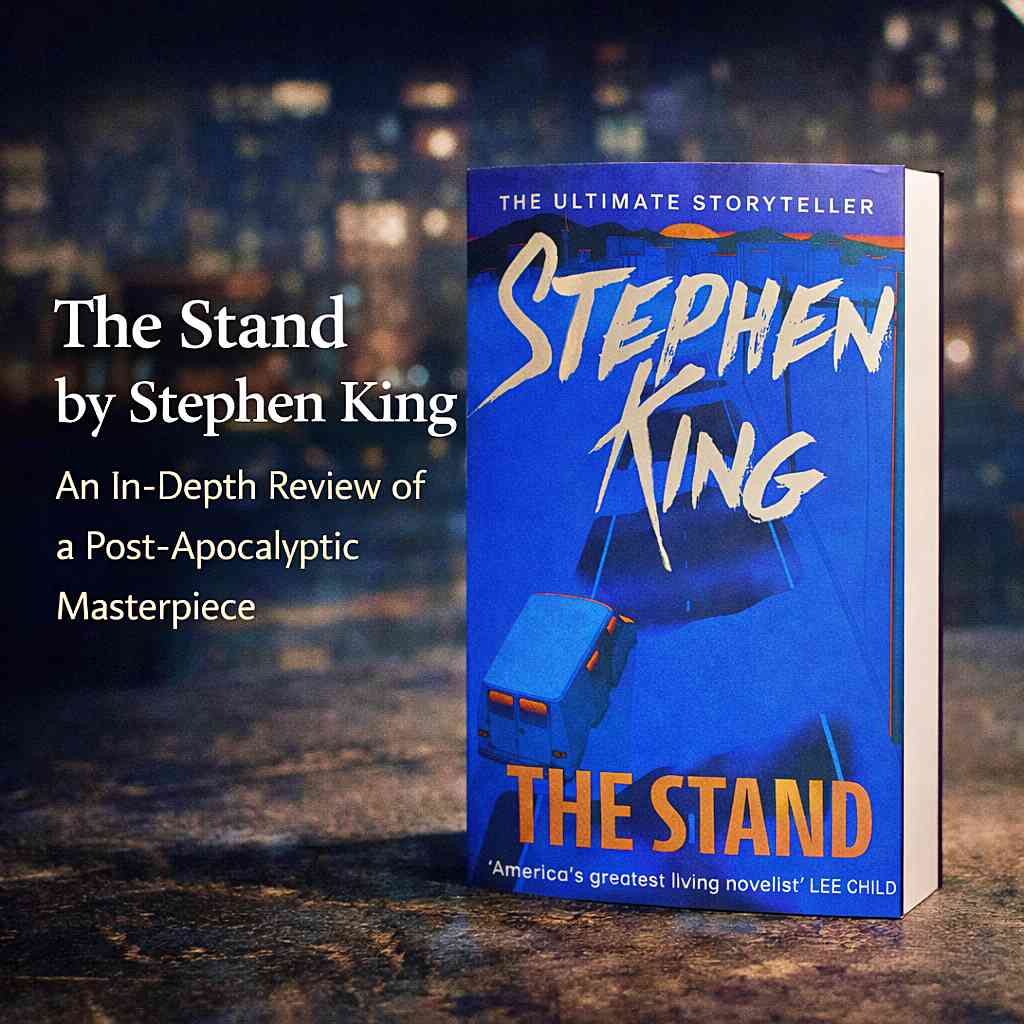
The Stand by Stephen King: An In-Depth Review of a Post-Apocalyptic Masterpiece
Stephen King’s The Stand is widely regarded as one of the most ambitious and enduring novels in modern horror and speculative fiction. First published in 1978 (and later expanded in 1990), the book blends apocalyptic horror, epic fantasy, and philosophical inquiry into a sweeping narrative about humanity’s collapse—and its attempt to rebuild.
More than four decades after its original release, The Stand remains a cornerstone of King’s bibliography and a defining work of post-apocalyptic literature.
Overview: A World After the End

The Stand begins with a catastrophic failure at a U.S. military facility, unleashing a genetically engineered superflu that wipes out over 99% of the world’s population. Known as “Captain Trips,” the virus spreads with terrifying speed, leaving civilization in ruins.
From this devastation emerges a story not just about survival, but about moral alignment. Survivors are drawn—through dreams and visions—toward two opposing figures:
- Mother Abagail, a 108-year-old woman representing faith, humility, and communal rebuilding
- Randall Flagg, the Dark Man, who thrives on chaos, authoritarianism, and violence
What follows is an epic confrontation between good and evil, framed not as a simple battle, but as a test of humanity’s values when laws, systems, and institutions no longer exist.
In-Depth Book Review
Scope and Structure: King at His Most Expansive
At over 1,100 pages in its uncut edition, The Stand is a true epic. King introduces a large ensemble cast, including:
- Stu Redman
- Frannie Goldsmith
- Larry Underwood
- Nick Andros
- Tom Cullen
Each character represents a different response to catastrophe—leadership, fear, denial, faith, cruelty—and King gives readers time to fully inhabit their perspectives. The novel’s first third, chronicling the spread of the virus and the breakdown of society, is often cited as one of the most chilling depictions of apocalypse ever written.
Unlike faster-paced dystopian novels, The Stand is patient. It lingers on silence, abandoned cities, and the psychological toll of being among the last humans alive.
Themes: Good, Evil, and Choice
At its core, The Stand is a moral novel. King has described it as a story about what happens “when people are stripped down to their moral essentials.”
Key themes include:
- The nature of good and evil – not as abstract ideas, but as daily choices
- Community vs. authoritarianism – Boulder’s democracy versus Flagg’s dictatorship
- Faith and free will – divine guidance without guaranteed outcomes
- The fragility of civilization – how quickly order disappears
Importantly, King avoids portraying good as flawless. The “good” characters make mistakes, argue, doubt, and suffer losses, which grounds the novel emotionally despite its mythic scale.
Writing Style: Accessible, Human, and Immersive
King’s prose in The Stand is straightforward but emotionally precise. He excels at interiority—capturing fear, grief, boredom, and hope in ways that feel deeply human. Even minor characters are given moments of clarity that make the world feel lived-in.
The expanded 1990 edition restored hundreds of pages cut from the original release, adding depth to character arcs and thematic resonance. Today, this uncut version is considered the definitive edition.
Stephen King official page – The Stand
https://stephenking.com/works/novel/stand-the.html
Criticism and Longevity
While The Stand is widely praised, it is not without criticism. Some readers find the final act less satisfying than the powerful opening, and others note that its depiction of good versus evil is unusually explicit compared to King’s more ambiguous works.
Despite this, the novel’s influence is undeniable. It has inspired countless post-apocalyptic stories across books, film, television, and video games.
Screen Adaptations: The Stand on Film and Television
The 1994 Miniseries
The first major adaptation of The Stand arrived as a 1994 ABC television miniseries, starring Gary Sinise, Molly Ringwald, and Jamey Sheridan as Randall Flagg. While constrained by network television standards of the time, the miniseries is fondly remembered for its faithfulness to the source material and strong casting.
IMDb – The Stand (1994)
https://www.imdb.com/title/tt0112182/
The 2020–2021 CBS All Access Miniseries
A more recent adaptation premiered in 2020, developed by Josh Boone and Benjamin Cavell, with Stephen King contributing a new ending. This version starred James Marsden, Whoopi Goldberg, Alexander Skarsgård, and Amber Heard.
Visually slick and more explicit than its predecessor, the 2020 series took narrative risks by restructuring the timeline. Reactions were mixed: performances—especially Skarsgård’s Flagg—were praised, while pacing and structural choices divided audiences.
IMDb – The Stand (2020)
https://www.imdb.com/title/tt1831804/
Book vs. Screen: Can The Stand Be Fully Adapted?
The Stand is famously difficult to adapt. Its power lies in internal monologue, gradual escalation, and thematic weight—elements that don’t always translate cleanly to screen. While both adaptations capture pieces of the novel’s scope, many readers agree that the book remains the definitive experience.
Final Thoughts
The Stand is more than a horror novel—it’s a sweeping meditation on humanity, morality, and what remains when the world ends. Its blend of apocalyptic realism and mythic storytelling makes it one of Stephen King’s most enduring works.
For readers willing to commit to its length, the reward is a deeply immersive journey that feels as relevant today as it did at publication.
Whether you’re discovering it for the first time or revisiting it decades later, The Stand earns its reputation as a modern classic.

 Previous Post
 Next Post