

 |
|
 |
 |
 |
+ 100 Total Pages |
Read it on All Devices |
+ 1,000 Active Readers |
Book Description |
|
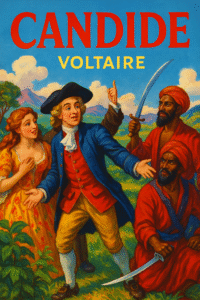
Candide (1759) by Voltaire is a satirical novella that mocks the philosophy of optimism, particularly the idea that “all is for the best in the best of all possible worlds,” which was famously espoused by the philosopher Leibniz. The story follows Candide, a naive young man raised in an idyllic and sheltered life, who is relentlessly taught by his mentor, Pangloss, that everything happens for a reason and that the world is always as it should be. However, as Candide journeys through the world, he faces a series of increasingly absurd and tragic events—war, natural disasters, betrayal, and suffering—that challenge his worldview. Along the way, he encounters a variety of colorful characters who embody the follies and vices of society. Despite the hardships and atrocities he witnesses, Candide’s optimism is tested, and he comes to the conclusion that while the world may be full of suffering, it is important to take action and “cultivate one’s garden,” implying the need for practical efforts and personal responsibility over philosophical speculation. Voltaire’s Candide is both a comedic and poignant critique of blind optimism, religious hypocrisy, and societal injustices. It remains one of the most enduring and influential works of the Enlightenment, using humor and wit to address profound philosophical and social issues. |
About Author |
| Voltaire |
|
Voltaire (1694–1778) was a French Enlightenment writer, historian, and philosopher, renowned for his wit, criticism of the established church, and advocacy for civil liberties, including freedom of speech and religious tolerance. Born François-Marie Arouet, Voltaire became one of the most influential figures of the Enlightenment and is considered one of the founders of modern Western philosophy. Voltaire’s works often challenged the social, political, and religious structures of his time, advocating for reason, individual rights, and a separation of church and state. His sharp criticisms of the French monarchy, the Catholic Church, and the prevailing social order earned him both admiration and controversy, leading to several periods of exile. His most famous work, Candide (1759), is a satirical novella that critiques optimism, religion, and societal corruption through the misadventures of its naive protagonist, Candide. The novella’s famous refrain, “All is for the best, in the best of all possible worlds,” is a biting critique of the overly optimistic philosophy of Leibniz. Voltaire’s other works include Letters on England (1734), which praised British society and ideas, and Philosophical Dictionary (1764), which advocated for secularism and freedom of thought. His works continue to be celebrated for their sharp social criticism, humor, and influence on the development of modern democratic values. |